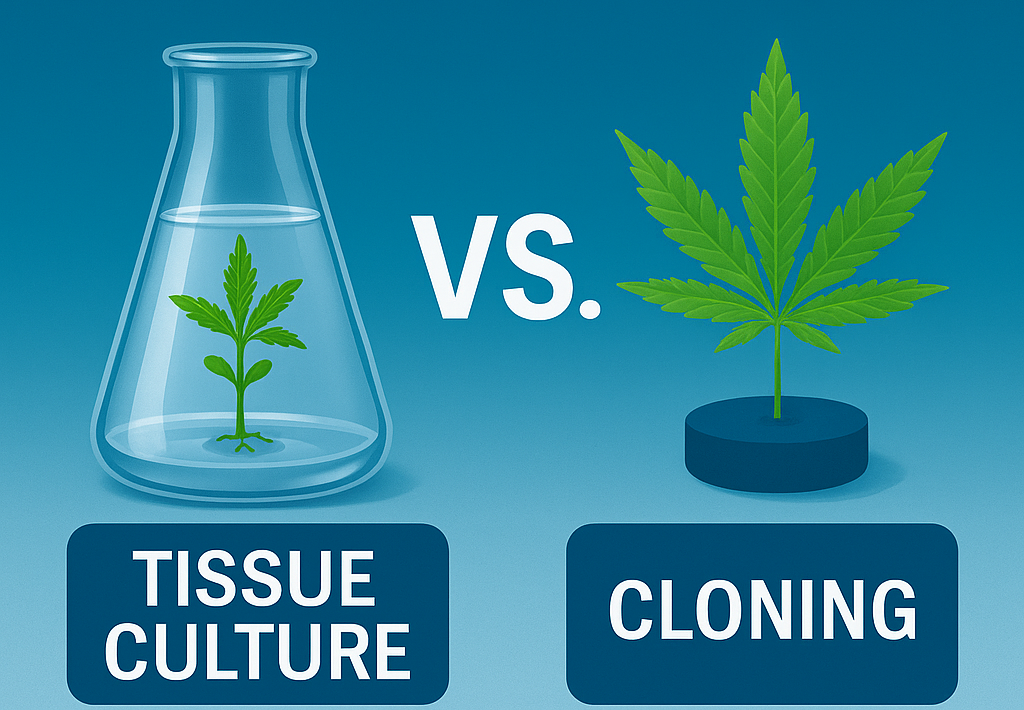
Why is tissue culture culture better than traditional cloning?
If you’re in commercial cannabis cultivation, you already know that cloning from mother plants has serious drawbacks—from pest and pathogens that can lead to dudding, and poor clone quality. Tissue culture solves these problems at the root.
Here’s why more commercial growers are turning to cannabis tissue culture—and why it might be time to reconsider how you propagate your genetics.
🔬 Cloning Carries the Problem Forward
Traditional cloning replicates everything—including viruses like HLVd, fungal endophytes, and pest pressures embedded in mother stock. Over time, these issues degrade plant health, yield, and product quality.
Tissue culture offers a clean-slate approach. By working at the cellular level—especially using techniques like meristem culture—we can remove pathogens and rejuvenate genetics to a near-original state.
📈 Scale Without Sacrificing Quality
Managing a mother room at scale is expensive. It takes up square footage, labor, nutrients, and energy—just to maintain a plant that’s slowly degrading over time.
Tissue culture allows you to bank hundreds or thousands of clean plants in cold storage or multiplication, freeing up space and giving you consistent, on-demand production material.
🔁 Consistency Is King
One of the biggest pain points in large operations is phenotypic drift. Two clones from the same plant can perform differently due to accumulated stress or epigenetic changes.
Tissue culture helps reset this drift, so your SOPs actually produce reliable results—every time.
🛠️ How We Help
At Shoots n’ Roots Labs, we specialize in tissue culture consulting for commercial facilities. Whether you’re starting from scratch or scaling your current lab, we provide:
– Customized facility planning
– On-site and virtual training
– SOP development tailored to your genetics
– Online classes for individuals or team training
📞 Ready to Propagate Smarter?
Let’s future-proof your cannabis operation with clean, consistent, scalable propagation.
👉 Book a consultation now here or, check out our online learning options for a deeper dive.
